May 17, 2012
Sconce Drop

There is a scene in “Moon Over Buffalo” when a case of mistaken identity results in an errant gunshot, and a wall sconce is the casualty.
When you’re doing this live on stage for two weeks of performances, the challenge is repeating the scene, the gunshot and the breaking of the sconce, each time.
Can you really break a sconce globe every performance? Would it be expensive? What about the shattered glass? Wouldn’t it be a hazard to the actors? Lot’s of work to clean up each time?
There must be a better way. Summon the techie!
There are definitely many ways to approach this, but the solution I took was fairly simple and safe. I started with a couple of wall sconce units. These were the kind that use gravity to hold the globe.

I removed the glass globes and replaced them with my own home made plastic ones. These were made from large empty ice tea jugs. (They didn’t start out empty, I had to drink the ice tea first.)
I had noticed that the top third of the jug somewhat looked like a sconce globe, so I cut them to shape you see in the pictures.
When I first mentioned this to the director, I got one of those looks that said “Really? I hired you?”. He did mention to me later that they look realistic, and being plastic, they are much safer on stage.
The sconce units were mounted upside down and the plastic globe was held in place by a wire or a clip. Remember these were the gravity type, so there is no built in mechanism to hold the globes, perfect for this application.
In the non-breaking unit on stage right, the globe is fixed in place by a paperclip going through the holes of the unit and under the plastic, locking it in.
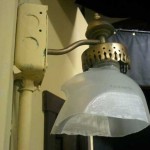
The bulb was then screwed in. (I used low 40-watt appliance bulbs.) Fortunately, the neck of the plastic was big enough to allow the neck of a standard light bulb to go through.
The stage left breaking effect unit was similar, but since it had to fall, the plastic was cut to allow the bulb to pass through without getting stuck.
The globe was then held in place by a stiff wire coming through the set wall and through the sconce holes and under the plastic. When the wire is pulled through the wall, just slightly, the globe is released and falls harmlessly to the floor.
All that is left to do is to synchronize the gunshot and glass crashing sounds with the globe dropping!
The low-tech way is to have a stage crew member, on cue, pull the wire from behind the wall. It would be effective, but require a techie to stand-by to coordinate with the actor’s movements and the sound and lighting effects.

I went a little less low-tech, and installed a remotely triggered solenoid.
The stiff wire going through the wall is connected to the solenoid piston. When the soleniod is energized, it pulls the wire and the globe drops. (Insert “tada!” sound here.)
Of course, the wire must freely pass through the set wall so there will be no snags.
To make the effect easily resetable for each performance, the stiff wire was bent on both sides of the set wall so as to limit the movement in both directions.
It would only move onto the set, away from the solenoid, enough to catch the plastic globe yet leave the piston within the capture range of the solenoid’s coil.

A bend in the wire behind the set limits this movement away from the soleniod.
On the sconce side of the set wall, a bend stops the wire from going all the way back through the hole, so it generally stays in the correct position for resetting before each performance. (Yes, a stage crew member has to do this.)
A screw eye is added behind the wall to create a support that keeps the wire inline with the hole in the wall and the solenoid’s pull axis.
Limiting the wire movement also keeps the piston from falling out of the solenoid’s coil. There’s a delicate balance point where the piston will stay in the coil’s “capture” range and still leave enough movement to actually pull the wire.
If I had to do this again, I’d probably use a solenoid with a captured piston rod which would reduce the complications. It would be similar to the one I used in my candlestick tipping effect. I was using a fairly quiet solenoid, but realized after it was installed that the sound wouldn’t matter as it would not be heard over the gunshot sound effect.
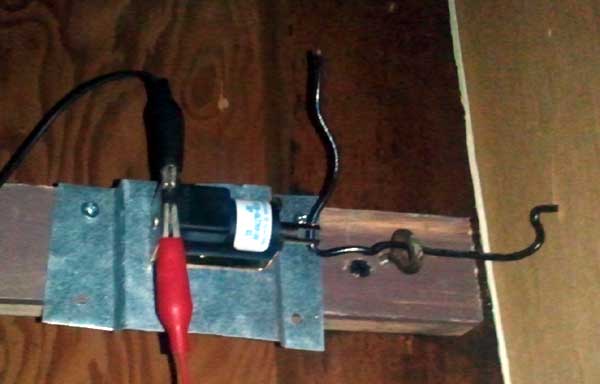
The solenoid is hooked up to a power supply behind the set, with a remote ‘on/off’ wire running all the way back to the computer, which has a USB controlled relay. This solenoid requires 12-volts DC so there was no problem using low-voltage wiring.
The sound playback control system (which happens to be SFX 6) synchronizes the effect by playing the gunshot sound and energizing the relay that energizes the solenoid, at the same time.
This is followed immediately by the sound of glass crashing and breaking and the sconce bulb being turned off. (SFX 6 sends a signal to the Horizon lighting system.)
It happens so fast, it looks like it all happens simultaneously.
It’s one of those fun cues that bring sound, lights and mechanics together as one. Long live the techie!

It’s a simple effect, and audiences love it.
Leave a Reply
You must be logged in to post a comment.